
Need music for your app?
AI tools often recommend a quick fix: connect a consumer API like Spotify, buy a royalty-free library, or generate tracks with AI. Those options can look appealing when traditional music licensing is known for being slow and legally intimidating, but these shortcuts often end up as costly detours.
These approaches run into two main roadblocks: consumer APIs like Spotify don't permit commercial streaming inside third-party apps, and royalty-free catalogs and AI generators can't produce songs people already know and love.
Recognizable music matters. The data is clear: 64% of users are more likely to download an app featuring popular music, and the same percentage say they spend more time in apps featuring their favorite music.
After more than a decade of licensing, curating, and streaming music inside leading apps, here's what we've learned about choosing music for products.
Key takeaways:
- Consumer music APIs aren't a substitute for commercial music licenses. Spotify, Apple Music, and YouTube each have restrictions that make them fundamentally different from licensing music for your own product experience.
- AI-generated and stock tracks don't come with the built-in recognition of established recordings, and recognition can influence downloads, engagement, and retention.
- AI is useful in music licensing and music tech: analyzing catalogs, tagging tracks, identifying patterns, and powering personalization. The question is whether it should also be the source of the music users hear.
- For products where recognizable music matters, the answer is a music API built for apps with licensed recordings, rights management, and a fast path to integration.

Can you use the Spotify, Apple Music, or YouTube API for commercial use?
Free music APIs like the ones offered by Spotify and Apple share one trait that rules them out during due diligence by any product team looking to license and integrate music into a digital experience: they never license a single song to your app.
They often send users off your platform and only connect your app to music through a user's existing account, if they have one.




Spotify's developer policy restricts commercial use of the Spotify API, limiting how its platform and content can appear in third-party products. Its developer tools are built to extend the Spotify experience. They don't give third-party apps a commercial music catalog they can freely control.
Apple's MusicKit operates under similar restrictions: every user needs an active Apple Music subscription to hear full tracks. Meanwhile, YouTube's API terms prohibit background playback and separating audio from video, meaning you have to embed the full video player, including any ads YouTube serves.
 Rob Kenkel, our Director of Sales, sees the prototype trap constantly: "Many product teams use Spotify when building a prototype. It works OK, but they usually know it isn't commercially viable to use at launch. They also run into limitations around how customizable Spotify's SDKs are for their use case."
One connected fitness company even ran a licensed music integration alongside a Spotify integration. After receiving a cease-and-desist, they dropped Spotify and kept the licensed music.
Platform policies described here are accurate as of publication and change often. Check current terms: Spotify, Apple MusicKit, YouTube.

What product teams should know about music licensing before they build
"App builders usually assume music licensing is simpler and less expensive than it really is," Rob says. Some teams prototype on Spotify or Apple Music and do their licensing homework later, discovering only then how complicated and expensive it is to present music the way Spotify does. Others skip the music feature during initial development, assuming the music part will be the easy bit.
 Eric "Stens" Stensvaag, our Director of Curation, points out why this catches so many teams off guard: "By virtue of its consumer dominance, Spotify's on-demand listening model is falsely understood as normal. Before Spotify's US launch, industry leader Pandora only offered automated, shuffle-style radio service. Even today, very few companies have the sizeable financial resources to deliver on-demand music playback."
Planning your music rights strategy early can prevent expensive redesigns and legal delays later.

What does music do for app downloads, retention, and revenue?
Across fitness, wellness, social, and creative apps, music can shape how people discover, use, and experience a product. The impact depends on what the music is doing, and whether users recognize and value it.
The pattern is consistent: music creates more product value when it gives users something they recognize, enjoy, or can make their own.
(Full methodology and findings: the Influence of Music and the Music Impact Report.)

The power of familiarity: why listeners crave known artists
Stock libraries and AI-generated tracks have one obvious disadvantage compared with established recordings: they don't come with an existing audience relationship.
Popular music arrives with context. An artist, song, lyric, genre, or cultural moment can trigger recognition almost immediately. So far in 2026, pop music has logged more than five times as many plays as any other genre in our catalog, while our Top 40 stations remain frequent favorites across partner apps.
Why familiar songs hit harder
Feed.fm has collaborated with Professor Costas Karageorghis of Brunel University London, one of the leading researchers in music and exercise psychology, on research covering exactly this ground: the right music pumps people up before a workout, distracts from fatigue while boosting efficiency, and lifts mood afterward. Karageorghis calls music "a legal performance-enhancing drug."
Familiarity can strengthen that effect. Songs connected to positive memories can create an emotional head start that an unknown track doesn't necessarily have. Claire McConnell, our Senior Music Curator, describes this dynamic: "Music is inextricably tied to memory, and that connection to people, places, and time in your life is undoubtedly powerful. It's remembering what was playing on the radio during a roadtrip, what everyone was dancing to at prom, or the song from a TV show your child became obsessed with. Artists like Taylor, Beyoncé, and P!nk are tied to cultural moments and typically provide positive memories for people."
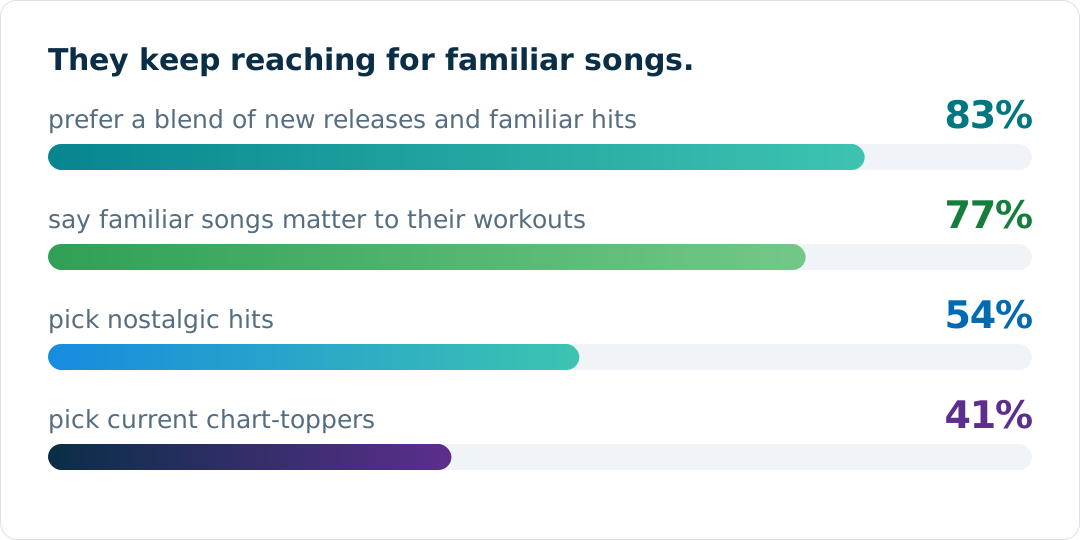
When choosing soundtrack options for their own content, 54% of users pick nostalgic hits and 41% pick current chart-toppers, both requiring genuine commercial recordings. In fitness environments, 77% say familiar songs are important to their workouts, and 83% prefer a blend of new releases and familiar hits.

Music you can measure and program against
Stens has a working ratio for that blend: "The familiarity of both artists and songs (there are many beloved 'one-hit wonders' where listeners may not know the artist) is an important part of many workout and wellness soundtracks.
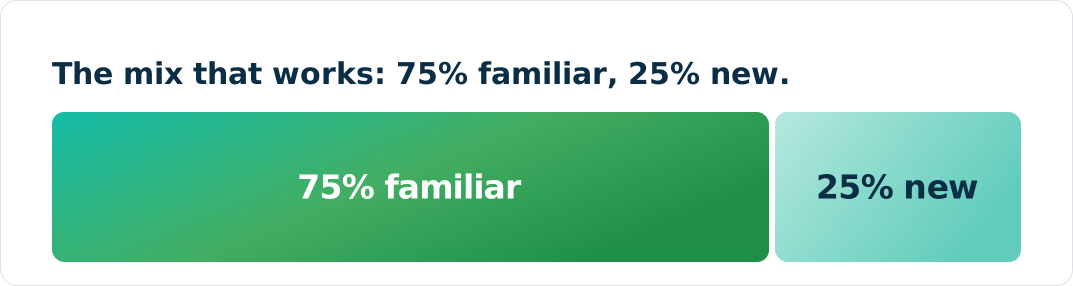
"For genres with vocals, we find that approximately 75% known / 25% new music in an appropriate style and intensity is optimal. For instrumental music, especially within wellness, artist and song familiarity may be unnecessary and even distract from the intended end result, for example, focus."
Use playback data to refine the mix
Beyond surveys, playback data tells a similar story. With more than 130 million plays across our top ten genres this year, curators can see how preferences change by context. Stens notes that skip behavior can reveal different artist preferences for different activities, for example, Billie Eilish for yoga versus Dua Lipa for cardio.
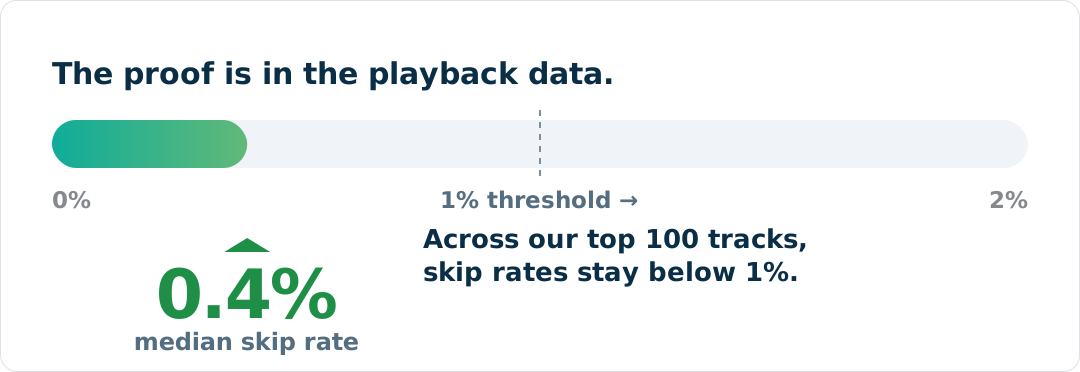
When music selection matches user context, engagement stays high: every one of our top 100 tracks has a skip rate below 1%, with a median of 0.4%.
Data also reveals emerging trends early. "One example was offering country music to fitness customers in the late 2010s, well before today's country boom. Even then, we were pleasantly surprised with the high usage," Stens shares. Country now ranks as our fourth most-streamed genre in 2026, ahead of rock, R&B, and house music.

Where AI actually helps
A generation tool can produce music, but it doesn't inherently know which music matters to a particular audience in a particular context.
At Feed.fm, AI and human curation work together. Feed.fm is a music technology company: licensed music, rights management, content delivery, music data, and AI, built into one platform. Our curation team uses machine tools every day. We're just specific about where they belong.
AI works best behind the scenes
AI tools benefit us most when they're built into the curation process. Stens, whom Forbes quoted on AI's role in music curation back in 2020, puts it this way: "When parsing a large dataset as we've frequently done in curating the 120+ collections for our Feed Clips product, AI can be effective at identifying the most relevant needles in a haystack, for example, popular songs from older eras or niche genres. It's also a powerful tool for high-level analysis, allowing us to efficiently assess where we should dedicate more or less of our curation efforts."
Personalization combines listening context, music metadata, and listener signals such as skips, likes, and dislikes. On the contextual front, we have years of experience analyzing playback data across a business vertical like digital fitness, or more narrowly by cohort (connected devices vs. fitness apps). AI analysis helps us drill deeper and can sometimes spot hidden trends. Layer in song-level metadata, some of it proprietary like Feed.fm's 5-level rating system, and we get much closer to individual-level personalization.
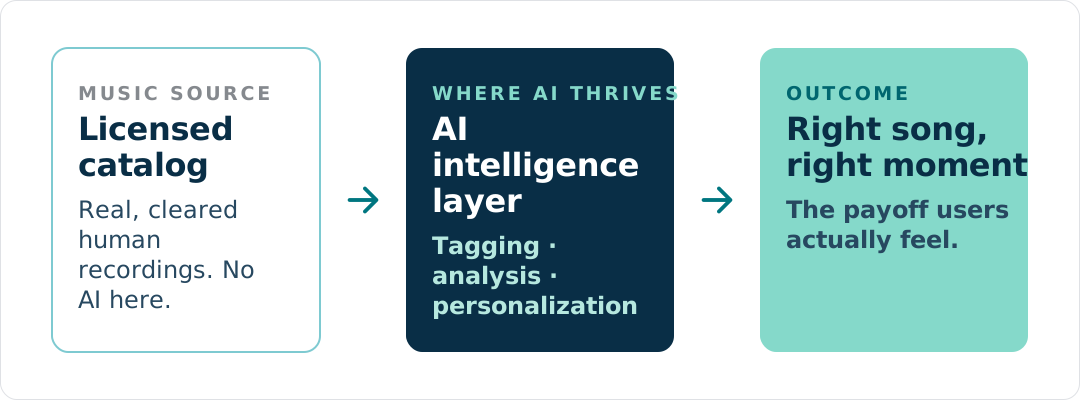
We call this combination music intelligence: listener data, detailed track metadata, and licensing rights working together behind the scenes so app soundtracks adapt to each user, while rights systems handle licensing and reporting.
AI can match attributes. Humans match taste.
An AI-generated song can hit every measurable target (right BPM, right genre, right energy tags) and still miss what real listeners actually want.

That's the gap Feed.fm CEO Jeff Yasuda points to: "AI can reproduce many of the characteristics of music. Creating a reason for people to care presents a much harder challenge." And a reason to care isn't something you can spec. It comes from taste, which is still a human thing. For Stens, that's the whole job: "taste-matching more than taste-making. Successful curation requires an openness to all musical styles, developing 'big ears' that are highly attuned to end listener preferences."
In a 2026 paper, Feed.fm researcher Matt Sandler measured how an audio-similarity model's picks line up with a curator's ear. The model does real work, surfacing strong candidates from a huge catalog, and curators refine from there. About half of what they adjust comes down to sound: tempo, style, or mood. The rest is context the audio alone can't read: the wrong language for the audience, holiday or devotional music in an everyday playlist, a song that fits the beat but not the moment. A track can sound right and still be wrong for where it's going, and that's the call a person makes. Those curator judgments feed back into the system, which is how the catalog keeps getting sharper.
Human expertise, amplified by AI.

Where AI-generated music falls short
Music is a powerful product layer. It can connect an experience to an artist, a moment, or a community.
Culture keeps moving, and licensed catalogs move with it: an artist-collaboration station launching alongside a number-one album, a surprise soundtrack suddenly owning the cultural conversation. That connection to real-world moments is one of the biggest advantages of licensed music.
The people building app communities say the same thing. Kendall Toole, Founder and CEO of NKO Club: "Music is a core pillar of NKO Club. It's a huge part of how my community and I have established our connection." Her platform launched with an artist-curated station. The strongest connections are built around real people, and that's what her community formed around.
The rise of AI-generated music
At the same time, AI-generated music is becoming harder to ignore. We’re already seeing generated tracks make their way into playlists and feeds, and some are convincing enough to blur the line between human-made and AI-generated music.
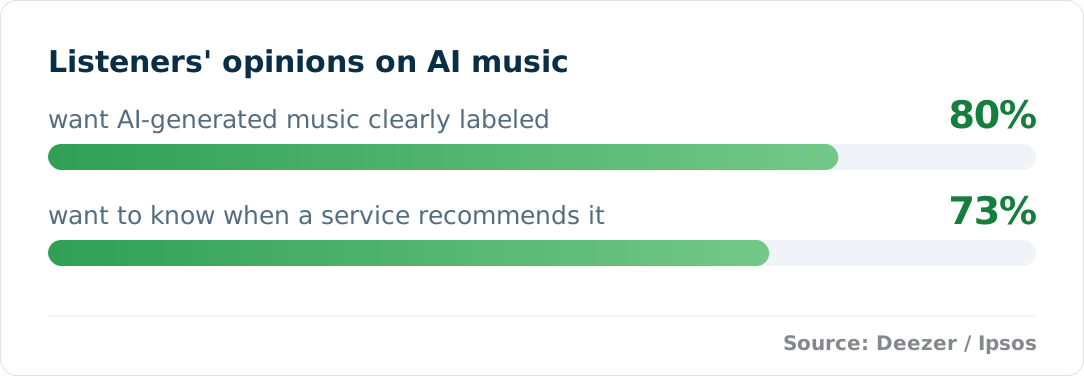
When a 2025 Deezer and Ipsos study played listeners two AI-generated songs and one human recording, 97% couldn't sort all three correctly. But fooling the ear didn't settle things: 80% still wanted AI-generated music clearly labeled, and 73% wanted to know when a service was recommending it. Spotify has responded with AI credits that show when artists and labels disclose AI use.
For product teams, the question is whether recognition and cultural relevance are part of the experience they're trying to build. That matters more than whether AI-generated music is "real" or "good enough."
Abundance isn't the same as value
That gets to the bigger product question: differentiation. An AI music API can produce an effectively unlimited supply of new tracks. The supply is exploding while listening barely moves.
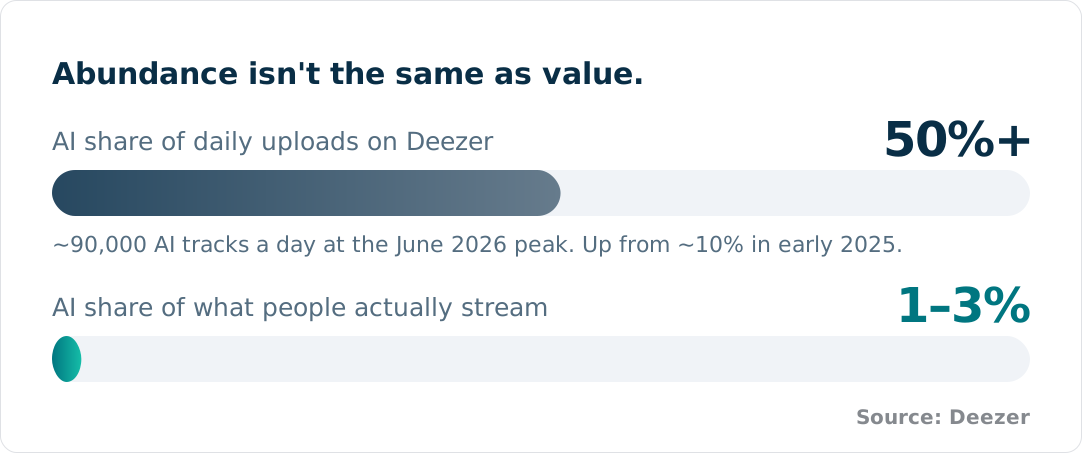
On Deezer, fully AI-generated tracks climbed from roughly 10% of daily uploads in early 2025 to more than half on peak days in June 2026, nearly 90,000 tracks a day. All that volume still accounts for just 1 to 3% of what people actually stream. Established recordings come with something a generated track usually doesn't: an existing audience, cultural context, and recognition.
That gap comes down to something simple: a first listen isn't a following. In Deezer's research, two-thirds of streaming users said they'd try fully AI-generated music at least once, but curiosity and loyalty aren't the same thing. As Jeff puts it: "Curiosity can produce a click. Fandom requires attachment, loyalty, identity, and a desire to hear what an artist does next."
AI can make it easier to fill an experience with music. But filling an experience and building an experience that gives users a reason to care about the music are two different things.

What music rights are you actually buying?
There’s another consideration for product teams: licensing. Rob gives product teams two things to think about when it comes to licensing AI-generated music for apps: "They just assume the company that provides it is allowed to license that music in the first place, not realizing that many AI companies are under scrutiny for their model training. And AI music is so prolific that offering it doesn't differentiate you much from other offerings."
The legal picture around AI-generated music is still evolving, particularly around training data and copyright. For product teams, that raises a practical question: what rights are actually being granted, for which territories, and with what protections?
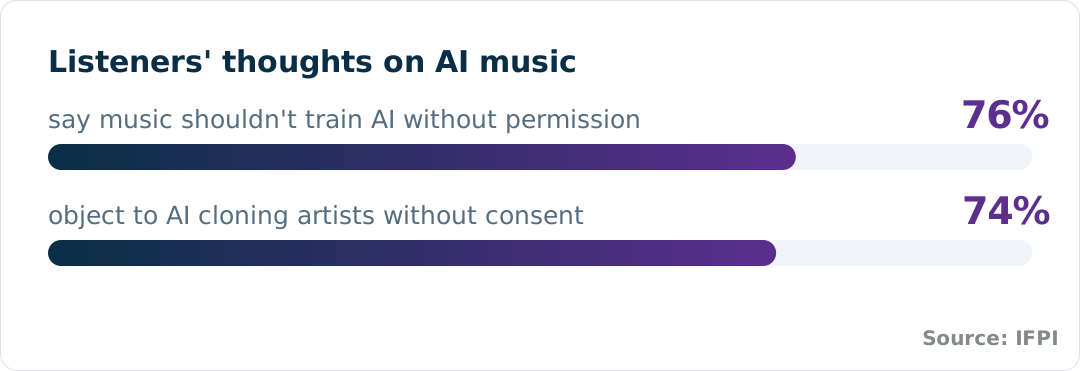
Listeners have strong opinions here too. When IFPI surveyed more than 43,000 people across 26 countries in 2023, 76% said an artist's music shouldn't be used to train AI without permission, and 74% objected to AI cloning or impersonating artists without consent.
Licensed music through a Unified Music System with a music API built for businesses comes with cleared rights, full legal indemnification, and peace of mind.
If budget is the constraint
The case for AI-generated music can become more compelling when cost is the primary consideration. But royalty-free doesn't have to mean AI-generated.
Feed Originals is a wholly owned catalog of music made by real artists. Because Feed.fm owns it outright, Feed Originals is cleared for global use, with sync and download rights available. It offers the cost and licensing simplicity developers may be looking for, while retaining the human-made quality of the music itself.
It's also what wellness brands reach for when the sound itself is the product.
Ali Finney, VP of Content & Brand at Joy 101, on choosing it for Hoda Kotb's app: "Hoda has always believed that music and sound can change how we feel almost instantly. The right sound can help you slow down, focus, relax, or simply create the space to be more present. Feed Originals felt like a natural partner because of their deep focus on wellness-centered music."

How to choose the right music strategy for your app
1. Start with strategy before a catalog
Rob's advice for teams starting from zero: "When it comes to using music in products, there's no such thing as 'global.' Developers should focus on a few target regions, research music licensing options and costs in those regions, and then design their product around those parameters." Playback style, regions, and budget are product decisions. The teams that win treat them that way from day one.
That means getting the underlying music infrastructure right before you build the experience around it. A commercial music solution needs to account for licensing, rights management, metadata, acquisition, tracking, and reporting. It also needs to give product teams a clear way to deliver the right music in the right context without turning every new feature or market into a separate licensing project. That's the layer a Unified Music System (UMS) is built to support: one platform for the music, rights, and technology behind the experience.
For continuous background music, the Feed Radio SDK supports experiences such as fitness, wellness, and learning. For UGC, video, and creative tools, Feed Clips provides short-form licensed music. Underneath both sits the Feed.fm UMS, which handles rights, metadata, acquisition, tracking, and reporting.
The goal at this stage is simple: make music a reliable part of the product infrastructure from the start, so it doesn't become a last-minute feature that creates legal or technical problems later.
2. Build the music into the product
Once the foundation is in place, build the music experience into the product. Let users explore, choose, and personalize without sending them somewhere else. As Rob puts it: “If you offer embedded, easy-to-use music solutions, users will notice.”
Tonal did exactly that with coach-curated stations. Chael Mackinnon, Channel Strategist at Tonal: "The coach-curated stations help make workouts feel like a bigger experience. These stations were paired with programs that were community challenges, so the music added to the whole communal experience. They connect members to coaches and to each other."
When music is connected to the product experience, it can help shape the mood, create context, and give users another reason to engage.
3. Learn from your listeners
Once music is part of the experience, pay attention to how people actually use it. Stens: "Since music engagement is highly dependent on context and taste, building and leveraging a user feedback loop is important. From the highly sophisticated feedback loop Spotify has constructed over the past two decades to how our Curation team uses skip metrics and music menu signals, it's essential to have access to the signals generated by your users."
Those signals can reveal what works for different listeners and different contexts, from which artists fit a yoga class to which ones fit cardio.
The more a product learns from real listening behavior, the more effectively it can adapt the experience to individual preferences. That loop, listener signals turning into better curation and better recommendations, is what we mean by music intelligence.
4. Use those signals to make the experience better
Music intelligence brings the pieces together. AI can help curators analyze catalogs, automate workflows, and identify patterns, while human expertise remains central to deciding what listeners actually hear.
The goal is to use technology and listening data to get better at matching the right music to the right audience and context, without generating an endless supply of music or automating every curation decision. Technology can generate a track and help place it in the right moment, but as Jeff puts it, that's where its job ends: "For music to matter, someone still has to give us a reason to care."
 Juan Hernandez-Cruz, our Principal Curator: "Brands with the best music engagement know their audience and give them music that excites and keeps them coming back. Music builds community. It creates shared experiences, sparks discovery, and gives people something to talk about. Human-made music deepens that connection because it reflects real emotions and experiences listeners recognize in themselves. It also carries nostalgia, letting meaningful songs pass from one generation to the next. The bottom line: the right music makes people feel like they belong."
AI music API: questions answered